 It’s day 1 of CES 2019 and we have already seen amazing technology and hardware from some of the big companies. AMD is rumored to launch the highly anticipated Ryzen processors which meet its competition as Intel has launched new 9th Gen desktop CPUs along with their 10mm Ice Lake processors. The company has announced that it will be adding six more 9th-gen Core processors, ranging from Core i3 to Core i9, set to release soon. Intel didn’t reveal details about the new processors but TechRadar did some research and found out details about the new processors. You can head below to take a look at the list of the new processors that Intel plans to roll out to the market. These new processors ditch the integrated GPUs in favor of reduced pricing which will allow Intel to compete with AMD Ryzen. While GPUs are important, users assembling their own desktop usually add a dedicated GPU which makes the Intel’s GPU useless. With the new F-series Intel is cutting down costs by removing GPUs so the system relies solely on the dedicated GPU installed by the user. For more visit OUR Forum.  We are still seeing the fallout from Microsoft’s contention campaign to encourage and sometimes force Windows 7 and Windows 8 users to upgrade to Windows 10. Now in what may be a precedent-setting case, the Finnish Consumer Disputes Panel has ruled damages caused by such an update to a Windows 8 user should be compensated by Microsoft, to the tune of 1,100 euro (about $1,254.) The complainant had asked for 3000 euro, saying in 2016 Microsoft automatically upgraded his Windows 8 PC to Windows 10, causing it to malfunction in a way Microsoft’s support was unable to fix and resulting in his camera surveillance software no longer working. He had asked to be compensated for the cost of replacing the cameras but was able to explain why this was needed. Microsoft did not offer a robust defense, saying the man’s claims were unreasonable, that he received free customer support, and that Microsoft was not responsible for his control software. Microsoft did not, however, deny that the new operating system could have been downloaded without his permission. The man insisted and the panel agreed Microsoft had no automatic right to install the upgrade from Windows 8 to Windows 10, and in addition had an obligation to perform the work correctly, which they did not. Learn more at OUR FORUM. 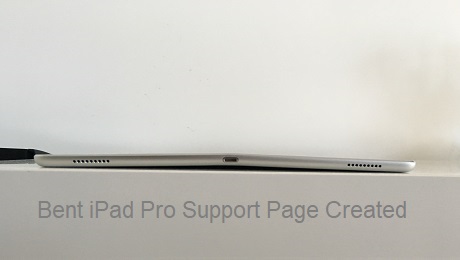 A number of complaints came to light recently from iPad Pro owners who were unhappy to discover that their expensive Apple tablets were bent. Apple responded to these complaints by saying that the iPad Pro's unibody design "meets or exceeds" all of its high standards. Now the company has gone further, publishing a support page explaining the manufacturer and testing process of the iPad Pro, and explaining that the way the tablet is made is the reason some people see a bend. Apple insists, however, that a bend should be within a tiny 400-micron tolerance. The support article is entitled iPad Pro unibody enclosure design, and on it, Apple explains "how the enclosure is made and tested". As we have discerned from complaints, it is the LTE version of the iPad Pro that is particularly susceptible to an unwanted bend, and Apple says -- as it has done before -- that this is because of the cooling down of materials used in the casing. Few people who have a bent iPad Pro will particularly care about why it is bent, being primarily concerned about the fact that it is bent. Apple insists that the "new iPad Pro models meet an even tighter specification for flatness than previous generations", and when it comes to the "flatness specification", there should be "no more than 400 microns of deviation across the length of any side", or -- as the company explains -- "less than the thickness of four sheets of paper". Follow the bent iPad Pro saga on OUR FORUM. |
Latest Articles
|