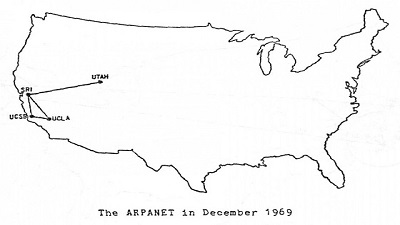
 Fifty years ago, two letters were transmitted online, forever altering the way that knowledge, information, and communication would be exchanged. On Oct. 29, 1969, Leonard Kleinrock, a professor of computer science at UCLA, and his graduate student Charley Kline wanted to send a transmission from UCLA's computer to another computer at Stanford Research Institute through ARPANET, the precursor to what we now know as the internet. ARPANET connected universities working for the Department of Defense under its ARPA (now DARPA) program for new military technologies. In 1969, only four universities had computers — which, Kline told OZY, were "room-sized ... with under-floor air conditioning" — connected to the network: UCLA, Stanford, University of California, Santa Barbara (UCSB) and the University of Utah. The message sent by Kleinrock and Kline was intended to be "login." Their system crashed, however, as soon as they typed the second letter. It took an hour to send the whole word, but by then, "lo" cemented its place in the internet's history. For Kleinrock, the message took on a completely different meaning, anyhow. “‘L’ and ‘O’ is ‘hello,’ and a more succinct, more powerful, more prophetic message we couldn’t have wished for," he told OZY. Two years later, in 1971, the first email was sent by MIT researcher Ray Tomlinson — which was also the first time the "@" sign was used to designate a specific recipient of a message. The World Wide Web, as we know it now, didn't get invented until 1989, when British computer scientist Tim Berners-Lee invented the web and the technologies to access, create and share web pages. He published the first web page in 1991. Browse over to OUR FORUM for more on this milestone.  The letter was aimed at Mark Zuckerberg, Facebook’s chief executive, and his top lieutenants. It decried the social network’s recent decision to let politicians post any claims they wanted — even false ones — in ads on the site. It asked Facebook’s leaders to rethink their stance. The message was written by Facebook’s own employees. Facebook’s position on political advertising is “a threat to what FB stands for,” the employees wrote in the letter, which was obtained by The New York Times. “We strongly object to this policy as it stands.” For the past two weeks, the text of the letter has been publicly visible on Facebook Workplace, a software program that the Silicon Valley company uses to communicate internally. More than 250 employees have signed the message, according to three people who have seen it and who declined to be identified for fear of retaliation. While the number of signatures on the letter was a fraction of Facebook’s 35,000-plus workforce, it was one sign of the resistance that the company is now facing internally over how it treats political ads. Many employees have been discussing Mr. Zuckerberg’s decision to let politicians post anything they want in Facebook ads because those ads can go viral and spread misinformation widely. The worker dissatisfaction has spilled out across winding, heated threads on Facebook Workplace, the people said. For weeks, Facebook has been under attack by presidential candidates, lawmakers, and civil rights groups over its position on political ads. But the employee actions — which are a rare moment of internal strife for the company — show that even some of its own workers are not convinced the political ads policy is sound. The dissent is adding to Facebook’s woes as it heads into the 2020 presidential election season. “Facebook’s culture is built on openness, so we appreciate our employees voicing their thoughts on this important topic,” Bertie Thomson, a Facebook spokeswoman, said in a statement. “We remain committed to not censoring political speech, and will continue exploring additional steps we can take to bring increased transparency to political ads.” Read more along with the letter on OUR FORUM.  A new research report from Activate Inc. says we’re spending much less time on Facebook than we used to. In 2017, Americans spent 14 hours per month on average on the social media site, and that number had dropped 26% to 9 hours per month in 2019, Activate CEO and cofounder Michael Wolf said today at the Wall Street Journal‘s Tech Live conference in Laguna Beach, California. Facebook is still way ahead of all its competitors in terms of membership numbers. It has more than 2 billion users worldwide. But the idea that those people are spending less time on the site could mean a lot to big brands that spend hundreds of millions to advertise on Facebook. Several researchers, including eMarketer, have also tracked the movement of younger users (12-34) away from Facebook and toward services like Instagram (which Facebook owns), Snapchat, and TikTok. Facebook also has a serious consumer trust issue after misusing private user data and, for years, being less than forthcoming about how it uses personal data in its advertising operation. The government is now looking closely at Facebook and its various businesses and considering reining in the massive company via new regulations. Politicians like Elizabeth Warren have called for the government to break up Facebook. Wolf said that Facebook won’t be disrupted and defeated by a single, similar company. Rather, a number of smaller and more focused communities will systematically skim off more and more of the time people spend on the general-purpose Facebook social network. Activate says people in the U.S. now belong to an average of 5.8 social networks, and projects that number will rise to more than 10 social networks by 2023. Facebook may realize this. The trend toward niche social networks may be one reason the company has been promoting private Facebook groups as a big part of its future. For more browse to OUR FORUM. |
Latest Articles
|