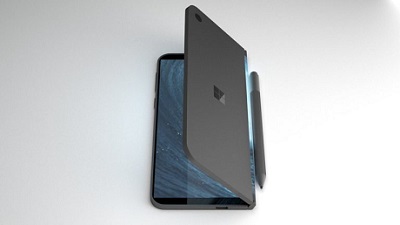
 Last week, a bunch of new patents for Microsoft’s foldable or dual-screen mobile devices were published on USPTO. The patents have revealed the ideas that Microsoft inventors have imagined for the company’s dual-screen device but as it is the case with all patent applications, there is no guarantee that this patented device will ever make it into a consumer product. There are two new patents that went unnoticed and both were published by USPTO on November 15. The first patent details a dual-screen device with the ability to adjust the volume and the second patent appears to detail another dual-screen device that can display data on first or second display simultaneously. The patent titled “VOLUME ADJUSTMENT ON HINGED MULTI-SCREEN DEVICE” was published on November 15 and it appears to detail a device featuring two displays, a front-facing camera on the first display and another front facing camera on second display. It also features a speaker. In the background section of the patent application, Microsoft explains the audio volume problems that many customers may have experience when using mobile computing devices. “Users interact with multi-screen mobile devices throughout a variety of positions, including holding the device vertically, holding the device with a primary screen facing toward the user, holding the screen with a second screen facing toward the user, and other positions and orientations. When viewing content on the screens in these varying positions, users may encounter challenges adjusting the audio volumes of different applications executed on each of the screens, or different audio-enabled graphical user elements displayed on each of the screens,” Microsoft writes. Want to know more visit OUR FORUM. 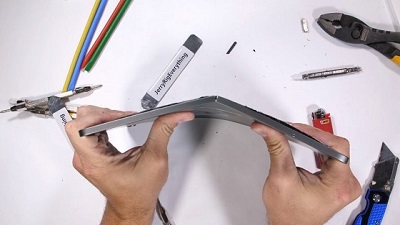 What would the Internet be without the JerryRigEverything scratch, burn and bend tests? He usually applies those to smartphones, but now it’s time for a tablet to go through it, Apple Pencil 2 included. Let’s see the result. The YouTuber breaks the pen in half and says that the accessory is a tad more resilient than the average wood pencil. A pressure sensitive tip and some magnets pop up. As far as the iPad Pro (2018) scratch test goes, the screen gets some tracks at level 6 out of 9, like the usual smartphone nowadays. Then the patient guy takes a cutter to the sides, back and edges. It’s all metal, so there’s no unpleasant surprise here. Extra bonus points go to the creator of the video for the Spider-Man drawing with the cutter at the back. The main camera is covered by sapphire glass, at least on paper, but in real life it’s normal glass, scratching at the same level 6. The lighter test saw the screen lasting 10 seconds under the heat of the flame, before turning off and then recovering slowly. The core point of the video was the bend test and it didn’t work out fine. The new iPad Pro (2018) is waaaay too easy to bend, sadly. JerryRigEverything didn’t even break a sweat when doing, but the screen did… break in a million pieces. The middle of the device is the weakest point and it’s very vulnerable. The worst thing is that the breakage leaves vital stuff open, like the battery pack and components. Want more visit OUR FORUM. 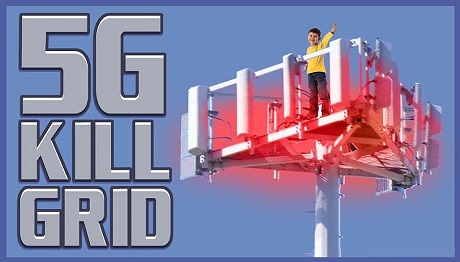 Microsoft is betting big on the 5G promise to transform computing as we know it despite a growing outcry that it poses serious health and environmental dangers. 5G, the next evolution of mobile networks, promises to transform the way we experience technology. 1G brought voice to a mobile platform. 2G introduced text. 3G delivered higher speeds and enabled music and video streaming. 4G or LTE brought up to 10-times higher speeds than 3G. 5G has been described as an evolution of mobile computing due to the many new computing scenarios it is expected to enable such as connected cars, advanced A.I., remote healthcare, advanced augmented (AR) and virtual reality (VR) and much more. 5G networks will have low latency (very responsive with no delay). They will be exponentially faster than current networks and more robust (able to handle more data). And they will be capable of connecting far more devices. Devices will not only connect and communicate with the network, but 5G's robust low latency qualities will allow devices to connect, communicate and "make decisions" between one another (i.e., smart cars) in real time. These capabilities are foundational to Microsoft's "Azure as the world's computer vision, " its intelligent edge and IoT infrastructure and its always connected PC, Artificial Intelligence (A.I.), Mixed Reality and xCloud game streaming strategies. Get the facts on OUR FORUM. |
Latest Articles
|