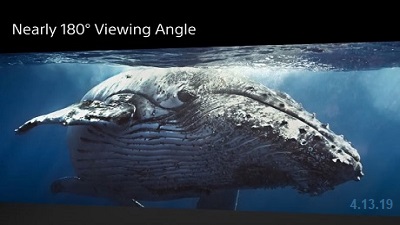
 At the National Association of Broadcasters (NAB) trade show in Las Vegas, Sony announced the world’s largest high-resolution display featuring a “16k” resolution, as well as Sony’s ‘Crystal LED’ display based on microLED technology. Sony’s 16k display has a diagonal measurement of 783” and has four times as many pixels as an 8K TV, but the company didn’t give details on the vertical resolution. The larger-than-life screen is 19.2 meters (63 feet) long and 5.4 meters (17 feet) high, so the vertical resolution likely isn't very high. This makes some sense, as walls can only be so tall, but it ultimately means Sony uses a non-standard resolution that is not a direct upscaling of 4K and 8K. Sony has started before that its modular and bezel-less Crystal LED screens can be arranged in any shape, even ones that don’t look like a typical TV. The Crystal LED screen Sony unveiled in Las Vegas is currently being installed at a new research center in Japan. These 16K screens will likely remain a high-end product for the corporate world for now, but Sony intends to sell smaller variations to offices, cinemas, and even consumers in the near future. MicroLED technology is basically OLED tech that doesn’t have burn-in issues because it doesn’t use any organic material to create the self-emitting diodes that don’t require a backlight (as LCDs do). There's more posted on OUR FORUM. 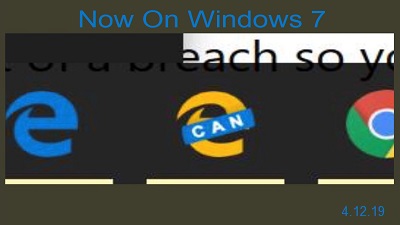 Windows 10 users and while the company earlier promised that it would bring the browser on other platforms such as Windows 7, Windows 8, Windows 8.1, and MAC OS, the launch date saw Microsoft announcing the browser as Windows 10 exclusive with the company saying that support for other platforms “coming soon.” Turns out that Microsoft kind of lied when it said the browser is Windows 10 exclusive at the launch date. As first spotted by Bleeping Computer, the Windows 10 Edge installer also works Windows 7, meaning you can download and install the Chromium-based Microsoft Edge browser on your Windows 7 PC. The only catch here is that you won’t be able to download the installer from Microsoft Edge website. Therefore, to taste the Microsoft Edge browser on your Windows 7 PC you have to download the installer from a Windows 10 PC, and then make a copy of the installer file, paste it to your Windows 7 PC. Follow the necessary steps and your attempt of installing the browser should be a success, you’ll also be able to use the browser and there shouldn’t be any issue with surfing the web. For more and direct download links visit OUR FORUM.  Microsoft has detailed a March attack on Windows customers in the satellite and communications sectors using "unusual, interesting techniques" that bear the hallmarks of APT group MuddyWater. The company's Office 365 ATP picked up archive (ACE) files loaded with the recently discovered WinRAR flaw, CVE-2018-20250, which has become widely used among cybercrime groups and nation-state hackers in recent months. The bug was co-opted for hacking after a February 20 report from Israeli security firm Check Point revealed that a malicious ACE file could place malware anywhere on a Windows PC after being extracted by WinRAR. Locations include the Windows Startup folder, where the malware would automatically execute on each reboot. A month before Check Point's report, WinRAR developers released a new version that dropped support for ACE because it was unable to update a library in WinRAR called Unacev2.dll that contained a directory traversal flaw. However, by March, when this attack was detected by Microsoft, it's likely a large chunk of the world's 500 million WinRAR users hadn't updated to the non-ACE version or hadn't removed the vulnerable DLL. The MuddyWater group's activities were first spotted in 2017. It is known to target users in the Middle East, Europe, and the US. The group frequently doctors up phishing documents to appear as if they're from security arms of various governments. For more visit OUR FORUM. |
Latest Articles
|