 Apple scans photos to check for child sexual abuse images, an executive has said, as tech companies come under pressure to do more t. o tackle the crime. Jane Horvath, Apple’s chief privacy officer, said at a tech conference that the company uses screening technology to look for illegal images. The company says it disables accounts if Apple finds evidence of child exploitation material, although it does not specify how it discovers it. Apple has often clashed with security forces and authorities, refusing to break into criminals’ phones and applying encryption to its messaging app in the name of protecting its users’ privacy. Speaking at the Consumer Electronics Show in Las Vegas, Ms. Horvath said removing encryption was “not the way we’re solving these issues” but added: “We have started, we are, utilizing some technologies to help screen for child sexual abuse material.” An Apple spokesman pointed to a disclaimer on the company’s website, saying: “Apple is dedicated to protecting children throughout our ecosystem wherever our products are used, and we continue to support innovation in this space. “As part of this commitment, Apple uses image-matching technology to help find and report child exploitation. Much like spam filters in email, our systems use electronic signatures to find suspected child exploitation. “Accounts with child exploitation content violate our terms and conditions of service, and any accounts we find with this material will be disabled.” The company did not elaborate on how it checks for child abuse images, but many tech companies use a filtering system called PhotoDNA, in which images are checked against a database of previously identified images using a technology known as “hashing”. The technology is also used by Facebook, Twitter, and Google. Apple made a change to its privacy policy last year that said it may scan images for child abuse material. Ms. Horvath defended Apple’s decision to encrypt iPhones in a way that makes it difficult for security services to unlock them after the FBI raised the prospect of another clash with the company by asking it to unlock an iPhone allegedly owned by a dead gunman who killed three people at a naval base in Florida last month. “End to end encryption is critically important to the services we come to rely on…. health data, payment data. Phones are relatively small they get lost and stolen. More posted on OUR FORUM.  In the days after the US government said it would bar Huawei Technologies Co from buying vital American components, the Chinese company’s founder, Ren Zhengfei, pulled together an emergency meeting of his top lieutenants at headquarters in Shenzhen. In a large conference room, the billionaire asked for a report from the head of each business unit on how they would be affected by the Trump administration’s ban, which blocks US companies from supplying everything from semiconductors to the software. Their assessments were dire. "We thought we had lost the world,” said Will Zhang, who attended as president of corporate strategy. It turns out they were far too pessimistic. Huawei recorded an 18% rise in sales to a new high of 850bil yuan (RM500.52bil) last year, although that was down from about 23% in the first half and missed its own internal targets. Company projections for 2020 are similar. Huawei holds the enviable position of being the world’s largest supplier of communications equipment to telecom operators and the largest smartphone maker globally after Samsung Electronics Co. Huawei isn’t just surviving; it’s actually thriving in some areas. The question is for how long. Last week, executives warned in a New Year’s memo that survival itself is a priority, urging employees to brace for a difficult 2020. Inventories stockpiled months in advance of the May blacklisting are drying up. The company can no longer count on momentum alone to drive the business, Rotating Chairman Eric Xu warned. How Huawei survived the US blacklisting could prove a case study in unintended consequences and a vast shift underway in global IT production. Huawei is a big customer for all of its suppliers, and a few actually cut ties after the blacklisting. Others lost out to rivals in Japan and South Korea. But American companies with extensive global operations, including Microsoft Corp and chipmaker Micron Technology Inc, found legal ways around the ban, leaning on the production outside the US so Huawei-destined products wouldn’t be hit. Huawei itself put armies of engineers to work redesigning products to reduce its reliance on American parts. Trump’s attack also had surprising implications for Huawei’s brand. A few countries, like Australia, agreed with the US president’s assessment and barred its equipment from their networks. But in the rest of the world, Huawei’s name recognition soared. After laboring in obscurity for decades, the maker of digital piping was suddenly front-page news everywhere. Beyond the US and its close allies, telecom operators wanted to find out what all the fuss was about. In China, consumers and carriers rallied to Huawei’s side in response to what they saw as unfair persecution, driving a sales boom. The Trump sanctions in some ways validated Huawei’s ability to develop cutting-edge technology, from fifth-generation networking gear to AI chips. Follow this in-depth on OUR FORUM. 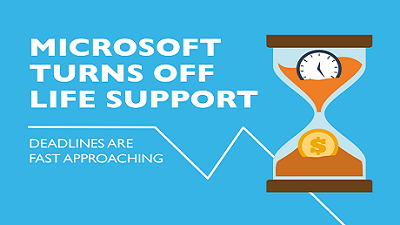 Several major Microsoft products will reach their end of support during 2020, with Office 2010, Visual Studio 2010, Windows 7, Windows Server 2008 (including 2008R2), and multiple Windows 10 versions including 1803 and 1903 being some of the most important ones. For products that have reached their end of support, Microsoft stops providing bug fixes for issues that are discovered, security fixes for newly found vulnerabilities, or technical support. Customers who still use end of service software are advised by Redmond to upgrade as soon as possible to the latest on-premise or cloud version to keep their systems secure and bug-free. However, as Microsoft says on its support website, "For customers requiring more time to move to the latest product, the Extended Security Update (ESU) program is available for certain legacy products as a last resort option. The ESU program provides security updates only for up to 3 years, after the End of Support date. Contact your account manager, partner or device manufacturer for more information." "Modern Lifecycle Policy covers products and services that are serviced and supported continuously" according to Redmond's support site with the company providing a minimum of 12 months' notification before ending support if no replacement product or service is available. According to Microsoft, a very long list of products governed by the company's Fixed Policy will also reach their end of support in 2020. "Fixed Lifecycle Policy applies to many products currently available through retail purchase or volume licensing," says Microsoft. This policy provides customers with at least 10 years of support (a minimum of 5 years of Mainstream Support followed by 5 years of Extended Support), with some exceptions. Besides the long list of products being retired, there are also many of them that will move to Extended Support from Mainstream Support in 2020. "Extended Support lasts for a minimum of 5 years and includes security updates at no cost, and paid non-security updates and support," says Microsoft. "Additionally, Microsoft will not accept requests for design changes or new features during the Extended Support phase." More in-depth details along with links, and detailed lists can be found on OUR FORUM. |
Latest Articles
|