 Our thoughts are private – or at least they were. New breakthroughs in neuroscience and artificial intelligence are changing that assumption, while at the same time inviting new questions around ethics, privacy, and the horizons of brain/computer interaction. Research published last week from Queen Mary University in London describes an application of a deep neural network that can determine a person’s emotional state by analyzing wireless signals that are used like radar. In this research, participants in the study watched a video while radio signals were sent towards them and measured when they bounced back. Analysis of body movements revealed “hidden” information about an individual’s heart and breathing rates. From these findings, the algorithm can determine one of four basic emotion types: anger, sadness, joy, and pleasure. The researchers proposed this work could help with the management of health and wellbeing and be used to perform tasks like detecting depressive states. Ahsan Noor Khan, a Ph.D. student and first author of the study, said: “We’re now looking to investigate how we could use low-cost existing systems, such as Wi-Fi routers, to detect emotions of a large number of people gathered, for instance in an office or work environment.” Among other things, this could be useful for HR departments to assess how new policies introduced in a meeting are being received, regardless of what the recipients might say. Outside of an office, police could use this technology to look for emotional changes in a crowd that might lead to violence. The research team plans to examine the public acceptance and ethical concerns around the use of this technology. Such concerns would not be surprising and conjure up a very Orwellian idea of the ‘thought police’ from 1984. In this novel, the thought police watchers are experts at reading people’s faces to ferret out beliefs unsanctioned by the state, though they never mastered learning exactly what a person was thinking. This is not the only thought technology example on the horizon with dystopian potential. In “Crocodile,” an episode of Netflix’s series Black Mirror, the show portrayed a memory-reading technique used to investigate accidents for insurance purposes. The “corroborator” device used a square node placed on a victim’s temple, then displayed their memories of an event on the screen. The investigator says the memories: “may not be totally accurate, and they’re often emotional. But by collecting a range of recollections from yourself and any witnesses, we can help build a corroborative picture.” If this seems farfetched, consider that researchers at Kyoto University in Japan developed a method to “see” inside people’s minds using an fMRI scanner, which detects changes in blood flow in the brain. Using a neural network, they correlated these with images shown to the individuals and projected the results onto a screen. Though far from polished, this was essentially a reconstruction of what they were thinking about. One prediction estimates this technology could be in use by the 2040s. Brain-computer interfaces (BCI) are making steady progress on several fronts. In 2016, research at Arizona State University showed a student wearing what looks like a swim cap that contained nearly 130 sensors connected to a computer to detect the student’s brain waves. The student is controlling the flight of three drones with his mind. The device lets him move the drones simply by thinking directional commands: up, down, left, right. Flying drones with your brain in 2019. Source: University of Southern FloridaAdvance a few years to 2019 and the headgear is far more streamlined. Now there are brain-drone races. Besides the flight examples, BCIs are being developed for medical applications. MIT researchers have developed a computer interface that can transcribe words that the user verbalizes internally but does not actually speak aloud. Visit OUR FORUM for more. 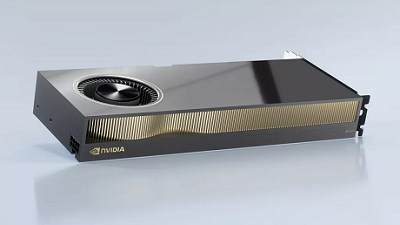 When Nvidia launched its RTX A6000 48GB professional graphics card last October, the company said that it would offer at least twice the performance of the company's previous-gen Quadro cards. These types of claims are not unusual, but how fast is the $4,650 RTX A6000 really in real-world benchmarks? (Interestingly, that's only $650 more than Galax's flagship RTX 3090 GPU.) Workstation maker Puget Systems decided to find out and ran multiple professional-grade benchmarks on the card. Nvidia's RTX A6000 48GB graphics card is powered by its GA102 GPU with 10,752 CUDA cores, 336 tensor cores, and 84 RT cores, and a 384-bit memory bus that pairs the chip with a beefy 48GB slab of GDDR6 memory. In contrast, Nvidia's top-of-the-range GeForce RTX 3090 consumer board based on the same graphics processor features a different GPU configuration containing 10,496 CUDA cores, 328 tensor cores, 82 RT cores, and a 384-bit memory interface for its 'mere' 24GB of GDDR6X memory. While the Nvidia RTX A6000 has a slightly better GPU configuration than the GeForce RTX 3090, it uses slower memory and therefore features 768 GB/s of memory bandwidth, which is 18% lower than the consumer graphics card (936GB/s), so it will not beat the 3090 in gaming. Meanwhile, because the RTX A6000 has 48GB of DRAM on board, it will perform better in memory-hungry professional workloads. While all GeForce RTX graphics cards come with Nvidia Studio drivers that support acceleration in some professional applications, they are not designed to run all professional software suites. In contrast, professional ISV-certified drivers of the Quadro series and Nvidia RTX A6000 make them a better fit for workstations. Not all professional workloads require enormous onboard memory capacity, but GPU-accelerated rendering applications benefit greatly, especially when it comes to large scenes. Since we are talking about graphics rendering, the same programs also benefit from GPU capabilities. That said, it is not surprising that the Nvidia RTX A6000 48GB outperformed its predecessor by 46.6% ~ 92.2% in all four rendering benchmarks ran by Puget. Evidently, V-Ray 5 scales better with the increase of GPU horsepower and onboard memory capacity, whereas Redshift 3 is not that good. Still, the new RTX A6000 48GB is tangibly faster than any other professional graphics card in GPU-accelerated rendering workloads. Modern video editing and color correction applications, such as DaVinci Resolve 16.2.8 and Adobe Premiere Pro 14.8, can also accelerate some of the tasks using GPUs. In both cases, the Nvidia RTX A6000 48GB offers tangible performance advantages compared to its predecessor, but its advantages look even more serious when the board is compared to graphics cards released several years ago. Like other modern professional graphics applications, Adobe After Effects and Adobe Photoshop can take advantage of GPUs. Yet, both programs are CPU bottlenecked in many cases, which means that any decent graphics processor (and not necessarily a professional one) is usually enough for both suites. Nonetheless, the new Nvidia RTX A6000 64GB managed to show some speed gains compared to the predecessor in these two apps as well. More facts and figures along with possible pricing can be found on OUR FORUM.  Microsoft has announced that Windows 10, version 2004 has now been added to the broad deployment channel and will be available to everyone via Windows Update. "Windows 10, version 2004 is designated for broad deployment," the company says in a status update on the Windows Health dashboard. "The recommended servicing status is Semi-Annual Channel." Microsoft officially started rolling out Windows 10 2004 (aka the Windows 10 May 2020 Update) in May 2020, but for many people, it wasn't yet being offered when checking via Windows Update. When Windows Feature Updates are first released, they are released under targeted deployment in order to test the quality of the build on targeted machines in an organization. "Targeted deployment refers to the phase immediately following the release of a new Windows version when it is recommended to conduct your organization's piloting process and to begin deployments to select devices, such as those with the most modern chipsets and capabilities," Microsoft explains. After Microsoft determines that the Windows version is ready for deployment on most or all devices, they change the Windows version to have a "broad deployment" classification. This means that all devices can be updated to Windows 10, version 2004 via Windows Update, unless they're affected by compatibility holds that block the update due to hardware issues. The release of Windows 10 2004 was not as bad as the one of Windows 10 1809, which many still see as arguably the buggiest Windows 10 version ever to see the light of day. However, Windows 10 2004 still managed to get out the gates with ten know issues under investigation, many of which are now already fixed. Microsoft added the known issues to the health dashboard right after starting the new release's rollout process, together with nine compatibility holds to prevent users of affected devices from being offered the Windows 10 2004 update. After addressing issues triggering blue screens when plugging or unplugging Thunderbolt docks, boot failures caused by the Disk Cleanup maintenance utility, as well as compatibility issues with numerous systems and hardware configurations, Microsoft has finally decided that Windows 10 2004 is ready for broad release to all customers. If you are not offered the Windows 10, version 2004 update via Window Update, then you should check the Windows 10 Health Dashboard for any known hardware blocks affecting your computer. According to the Windows 10 Health Dashboard, the only known blocks for Windows 10 2004 updates are for devices with Conexant ISST audio drivers. As Home, Pro, Pro Education, Pro for Workstations editions of Windows 10 1909 are reaching the end of service on May 11, 2021, Microsoft is now allowing a limited set of customers (with devices running Windows 10 1903 and higher to upgrade to the latest released version, Windows 10, version 20H2. These customers are known as "seekers," which is short for users who are manually seeking to update to the latest Windows version by clicking "Check for updates" via Windows Update. Microsoft says that it's also "slowly throttling up availability over the coming weeks to ensure a reliable download experience." If you are running older Windows 10 versions, you are strongly advised to update to a newer version to continue receiving timely security updates. |
Latest Articles
|